







Maureen Reardon Gullekson has spent time in Santiago de Compostela, Spain, as a Camino Companion volunteer. She writes on her experience.
About a year ago, the FCJ Sisters graciously approved my request for a summer internship with Camino Companions, a ministry serving English-speaking pilgrims at the pilgrim office in Santiago de Compostela, Spain.
This internship, required for my Master’s degree in Theology and Ministry in Boston College, was designed to help me discern a call to spiritual accompaniment. Though uncertain of what awaited me, the eight weeks I spent with Camino Companions from May to July 2026 proved deeply rewarding.
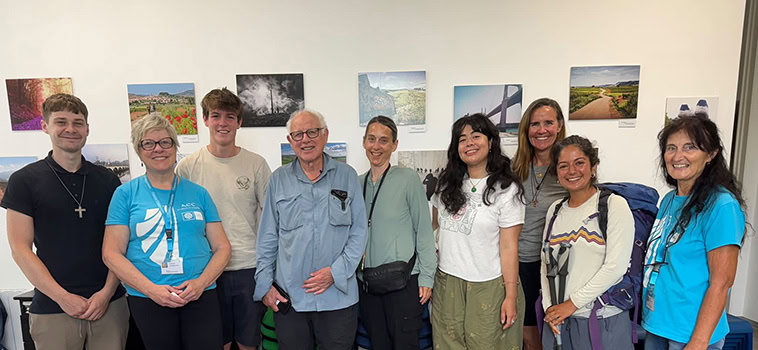
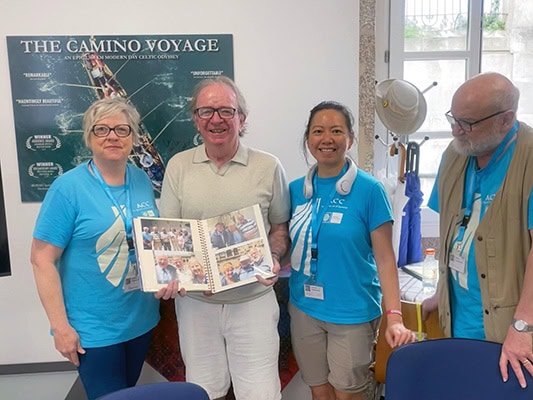
Encountering a diverse array of pilgrims made each day unique. Our schedule was steady: daily Mass, group sharing, a video on St. James and the Camino, and one-on-one conversations with pilgrims. During quieter moments, one or more of us would “intentionally loiter” in the common area where pilgrims exited after receiving their Compostela, the certificate marking their journey’s end.
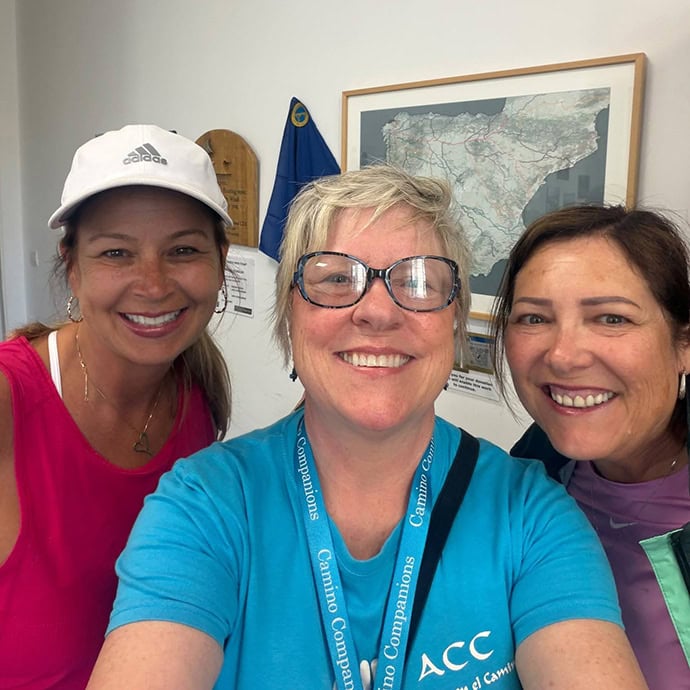
At first, the phrase “intentional loitering” puzzled me when Sr. Katherine fcJ suggested I try it. The words sounded contradictory – “intentional” implies purpose, while “loitering” suggests aimlessness. But I soon realized it meant being present simply to welcome pilgrims. While many English-speaking pilgrims found their way to Room 6, our welcome center, loitering introduced me to people from many countries. I would often guess a pilgrim’s native language or country. “Congratulations” was always a good starting point; if I was met with confusion, “felicidades” usually drew a smile and a grateful “gracias.” Even when language was a barrier, a smile bridged the gap. During these moments, we volunteers played many roles—cheerleader, photographer, tour guide, information provider, even surrogate family. Intentional loitering wasn’t aimless; it was about being present for a purpose, not with a purpose.
When intentional loitering meets intentional listening, spiritual accompaniment happens, even when God isn’t named. This means listening without judgment or hurry and holding space for another’s emotions: joy, exhaustion, confusion, grief, or sadness. It’s also about noticing where the Spirit may be present in people and experiences. Even brief conversations became genuine opportunities for connection. Simple questions such as, “Where are you from?”, “Which Camino did you walk?”, “What touched your heart?”, “What will you bring home?”—all fostered accompaniment.
When intentional loitering meets intentional listening, spiritual accompaniment happens, even when God isn’t named.
Jesus didn’t just walk with others, he lingered, listening deeply to their stories, concerns, and fears. He asked questions such as “What do you want me to do for you?” and “Who do you say that I am?” His willingness to pause and be present fostered genuine connection. Early in his ministry, he lingered on the shores of Galilee, meeting and inviting his disciples. Later, while loitering at a well in Samaria, a conversation helped a woman recognize God’s presence. By meeting people where they were, Jesus made God’s presence known.
Loitering is often misunderstood as something to avoid, or even as illegal. Signs warn, “no loitering.” But when done intentionally to meet others, it becomes an opportunity to truly see, listen, and pay attention. When Jesus loitered, it changed lives. As Greg Boyle, SJ, says, “The Christ in me sees the Christ in you,” a sentiment that fits intentional loitering with pilgrims in Santiago. Language and topic don’t matter; what matters is the sacred encounter, my imago dei meeting yours.
The Christ in me sees the Christ in you.
Greg Boyle, SJ
Returning home, I had much to reflect on, but intentional loitering resonated most. At first, it felt pointless, but I now see that loitering in daily life is a way to accompany others, even briefly. We often discussed with pilgrims how to bring the Camino home. Short, genuine encounters were time well spent. The response may not always be as warm as in Santiago, but the intent – seeing Christ in others – remains the same.