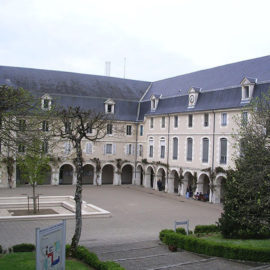
The political and social climate in France in 1847 was anything but favourable to religious congregations. Despite a decree prohibiting the establishment of further religious communities, the Archbishop of Paris, Monseigneur Affre, who had known Marie Madeleine when he was a priest in Amiens and was her friend and a supporter of the Faithful Companions of Jesus, warmly welcomed the Sisters to his Archdiocese.
It was not a sudden impulse that directed Marie Madeleine to Paris. She had considered the idea for some time. A house in the capital would provide the opportunity to work with the poor, be a pied à terre for herself and her sisters on their frequent journeys, and provide a more convenient administrative centre for the Society. Further, it could become her place of residence when she was not visiting the houses.
It was January 1848 when Marie Madeleine bought the Paris property and political tension was high. The unrest of subsequent months culminated in a revolution that summer. There were violent clashes in the streets, many deaths and much sorrow. In July, Monseigneur Affre lost his life in an heroic attempt to bring peace at the barricades. Marie Madeleine wrote, From time to time, just when the need is greatest, God raises up a protector for us; he then withdraws him, leaving us again without human support. Monseigneur was our one support in Paris.
In the months following the summer Revolution, Marie Madeleine remained in Paris to care for the children in greatest need. She washed, dressed and fed them. To those advising her to spare herself, because of her age and poor health, she gave a characteristic reply: We should work not as ladies to pass the time but as do the poor to earn their living. Having experienced life as a lady she was able to appreciate the difference!
Throughout the political unrest the Sisters worked for the poor of the district. Eventually a school was established, together with an administrative centre and a novitiate. The house became Marie Madeleine’s residence and she lived there between her visits to the other houses in France, as well as to those in Italy (Savoy), Switzerland, Ireland and England.
The Paris house was born amidst great political unrest and uncertainty, and Marie Madeleine always encouraged her sisters to have a special regard for this house. It was here that she died on April 5th 1858.
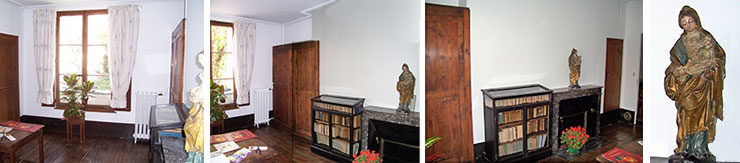
To this day, the room in which she died is preserved as a place of prayer and pilgrimage. Beside her room is a small museum containing things precious to her memory.
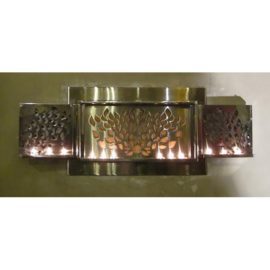
Marie Madeleine’s room in Paris, the place where she died
Travelling from Issoudun to Bourges you normally (though not inevitably) enter the city over Pont d’Auron and it is from this bridge that Notre Dame du Pont, the statue preserved in Marie Madeleine’s room in Paris (and shown at the bottom right), takes its name. Originally it stood in one of the niches in the bridge. Rescued by M de Bengy to prevent desecration, it was later given by him to Mére Legrand around 1827/8 and taken to Châteauroux. It was there that in 1830/1 Mère de Courville experienced it weeping. Since that time its journey has taken it from Châteauroux to Turin, Carouge and finally Paris in 1850.
A tour of the artefacts from the life of Marie Madeleine in our Paris museum
Click on the images to see their captions and take a tour of the museum.
View of Museum Room 1
View of Museum Room 2
View of Museum Room 3
View of Museum Room 4
View of Museum Room 6
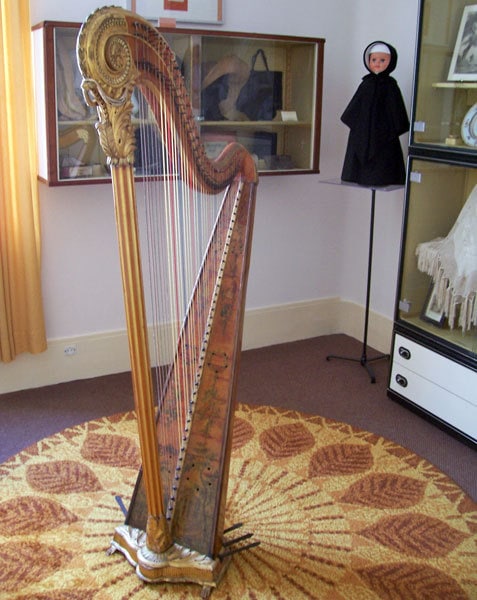
Very beautiful harp belonging to Marie Madeleine, dating from the 18th or perhaps even the 17th century. The wood is decorated with floral and leaf paintings. This harp was re-strung some years ago. We have kept the original strings.
Marie Madeleine’s wedding shawl of silk, completely hand-embroidered, magnificent, a marvel, a museum piece.
A second silk shawl, completely embroidered by hand, of the same era prior to the French Revolution. At the back is a drawing representing the manor at Parassy, 10 km from Bourges, which Marie Madeleine received as a marriage dowry. It was in Parassy that she hid Father Varin at the time of the hundred days of Napoleon.
A drawing done by her brother Claude de Bengy at the military college; thanks to which her property would be protected at Parassy.
A quartered coat of arms of Marie Madeleine: The fiefdom of the two families in Berry was in the dukedom of Le Dauphin, the king’s eldest son. In 1378 Jean de Bonnault received from the Duke of Berry a gift of 130 gold ecus, for services rendered to the throne. The de Bonnault family’s coat of arms are 'in azure with a gold chevron, accompanied at the top with two gold stars and at the bottom with a live dolphin, wearing a gold crown'. The de Bengy family coat of arms dates back to the 15th century, 'in azure with three silver stars placed two and one'. The de Bengy family motto is 'deeds not words'.
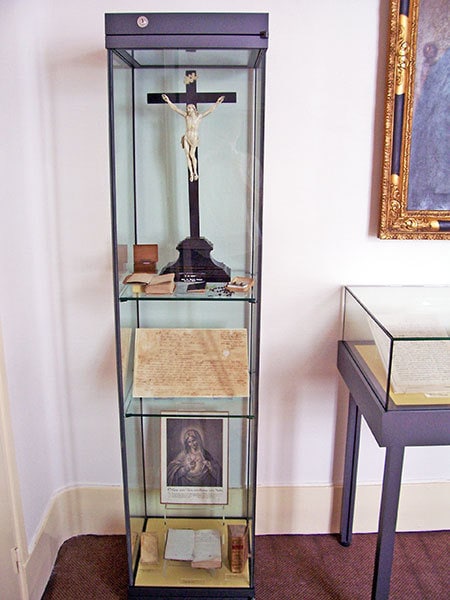
A crucifix from the chapel of the Sacred Heart Sisters in Amiens before which Marie Madeleine heard the words 'I thirst' in 1817. At that time she offered herself with her son to do the will of God. The Sacred Heart Sisters joyfully offered us this crucifix.
The crucifix from the chapel of the Sacred Heart Sisters in Amiens before which Marie Madeleine heard the words I thirst in 1817. Also shown are a small notebook and rosary used by Marie Madeleine and a small wooden casket containing some relics.
Various objects: Top shelf: Death announcement of Reverend Mother de Bonnault d’Houet, 5 April 1858 at Paris; whip to discipline herself, composed of metal chains and points; hair-shirt which she wore against her skin as a penance; picture of Blessed Sr. Rosalie Rendu, Daughter of Charity of St Vincent de Paul, who sent her orphans to Gentilly. Bottom shelf: Linen used by Marie Madeleine; Photograph of her room as it was until 1970.
Family portraits: Eugène, Viscount de Bonnault d’Houët, her son, 1805-1875; Louise de Bosquillon d’Aubercourt, Viscountess de Bonnault d’Houët, her daughter-in-law, 1815-1890; Angèle de Bengy, wife of Gabriel Gassot de Champignu, her sister, 1788 – 1861.
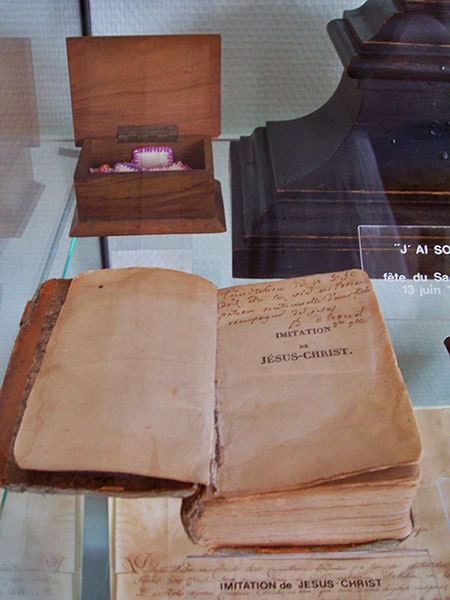
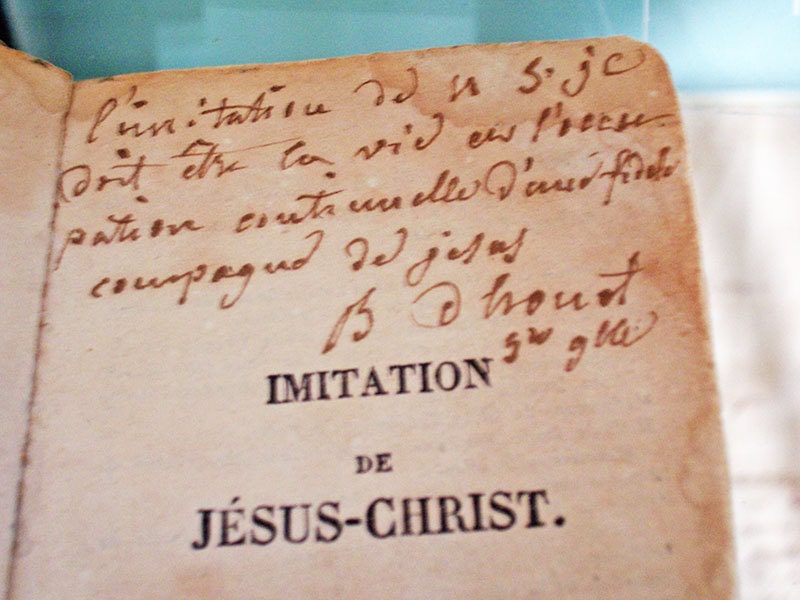
'The Imitation of Jesus Christ', a book offered to an FCJ.
'The Imitation of Jesus Christ': On the fly-leaf Marie Madeleine has written: The imitation of Our Lord Jesus Christ must be the life and continual occupation of a faithful companion of Jesus and it is signed: B. D’Houet sup. general.
Various: soft doeskin gaiters which Marie Madeleine wore against the cold on her numerous journeys in horse-drawn carriages; a cloth bonnet finely woven, which she wore under her black widow’s bonnet in the style of Berry; a chipped water-jug which she used in her room; an 'Agnus Dei', a small sculptured alabaster frame, representing a lamb on an altar with the words Behold the Lamb of God who takes away the sins of the world, give us peace; indulgences brought back from Rome (and perhaps given by the Pope).
Picture representing the Sacred Heart of Jesus. Having bought in a bookshop some brochures which to her seemed dangerous for one’s faith, she and her brother Philippe burnt them in the fire-place of their sitting room. The next morning among the ashes in the fire-place this picture was found untouched. Marie Madeleine kept this small old picture preciously all her life and carried it on her journeys as a guarantee of divine protection. (see Life of Mme de Bonnault d’Houët by Abbé Martin, p.57)
Death announcement of Reverend Mother de Bonnault d’Houët, 5 April 1858 at Paris; Sermon given at the time of the burial of Marie Madeleine, April 1858, outlining the main events of her life.
A book of testimonies collected after the death of Marie Madeleine from people who lived with her or who had met her, which have been used for her Cause in Rome.
You are the sign that a different world is possible: a world of fraternity and friendship, where conflicts are not resolved with weapons but with dialogue. Yes, with Christ it is possible! (Jubilee of Youth, August 2025)
On the slopes of Mount Merapi, farmers are rediscovering a sacred connection with water, nature and faith, and working together to protect the environment that sustains them, explains Sr Inez fcJ. ...
FCJ sisters Lynne and MaryAnne will be running 5K for CAFOD again this November at the iconic Silverstone racing track, accompanied by FCJ Companions in Mission and other friends.Their fundraising page is now live: tinyurl.com/TeamFCJSilverstone2026...
New members are welcome to this international reading group hosted online by FCJ Centre St Hugh's, as they start reading a new book: The Afternoon of Christianity: The Courage to Change, by Tomas Halik. ...
Every July Milltown Malbay, Co. Clare, hosts the Willie Clancy Summer School (Scoil Samhraidh Willie Clancy). FCJ Spirituality House An Teach Spioradálta at Spanish FCJ Spirituality House, Spanish Point opens its doors to attendees for reflective time amid all the music workshops, sessions and set dancing. ...
Every year FCJ Spirituality House opens its doors to participants in the annual Willie Clancy Summer School, the traditional music festival held in July in Milltown Malbay.
The theme for the 2026 academic year at Genazzano FCJ College is "Lead with Dignity, Act with Gentleness". Mrs Loretta Wholley, College Principal, reflects on it. ...
Why not support this energetic, faith-filled and cause-driven FCJ sisters? They will be running for CAFOD again this Autumn. CAFOD is the agency for overseas development of the Catholic Church in England and Wales. ...
Thank you for the messages and tributes to Sr Beatrice fcJ who died on 12th July. She had been looking forward to her annual pilgrimage to Lourdes with the Diocese of Salford. ...
A group organised by the FCJ Young Adult Network has recently been on pilgrimage to Assisi. This year marks the 800th anniversary of the death of St Francis (1181-1226). ...